Information is free. Attention is scarce.
In 2026, the creators who win aren’t selling better content — they’re selling experience-based courses.
Here’s why “Harry” is broke, “Anna” is scaling effortlessly, and how shifting to an experience-based course model changes everything.
The Shift from Content to Experience-Based Courses in 2026
Let’s address the elephant in the room.
Five years ago, the formula was simple: Record a video course, slap up a sales page, and generate six figures. You were selling Information. Back then, information was scarce.
Today, information is a commodity. AI usage among researchers and creators has surged to 84% in 2025, meaning anyone can generate a ‘how-to’ guide in seconds. To win, you must stop selling information and start selling a transformation.
Your potential student can open an AI model and ask: “Write a comprehensive 10-step guide to [Your Niche].” They get a tailored, accurate answer in three seconds. For free.
If your business model relies on selling “content,” you are in a race to the bottom.
Why AI Killed the Traditional Content Course
Recent studies show that engagement with AI-generated articles dropped by 40% as readers grow exhausted with formulaic, robotic text. To win, you must master the experience economy in online education 2026—shifting from being a provider of information to a purveyor of experience-based courses that deliver real transformation.
The winners will be the ones who design the best Psychological Ecosystem.
You aren’t selling answers anymore; you are selling Trust, Context, and Momentum. To prove this, let’s run a simulation.
The Harry vs Anna Simulation
Meet two creators: Harry and Anna.
They have the exact same niche. The same traffic. The same price tag.
Harry is burning out with a conversion rate of 0.8%.
Anna is scaling effortlessly at 3.5%.
The difference isn’t luck. It’s psychology. Let’s break down exactly where Harry creates friction—and where Anna creates flow.
First Impressions: Building Trust in the Experience Economy
The Corporate Shield vs Raw Authenticity
In the 2026 Experience Economy, humanity is your strongest currency. Readers are exhausted—engagement with robotic, AI-generated text has plummeted by 40% as people seek authentic human connection. This is where ‘Neuro-Verification’ through raw video becomes your unfair advantage.
🛑 Harry’s Approach: The Corporate Shield
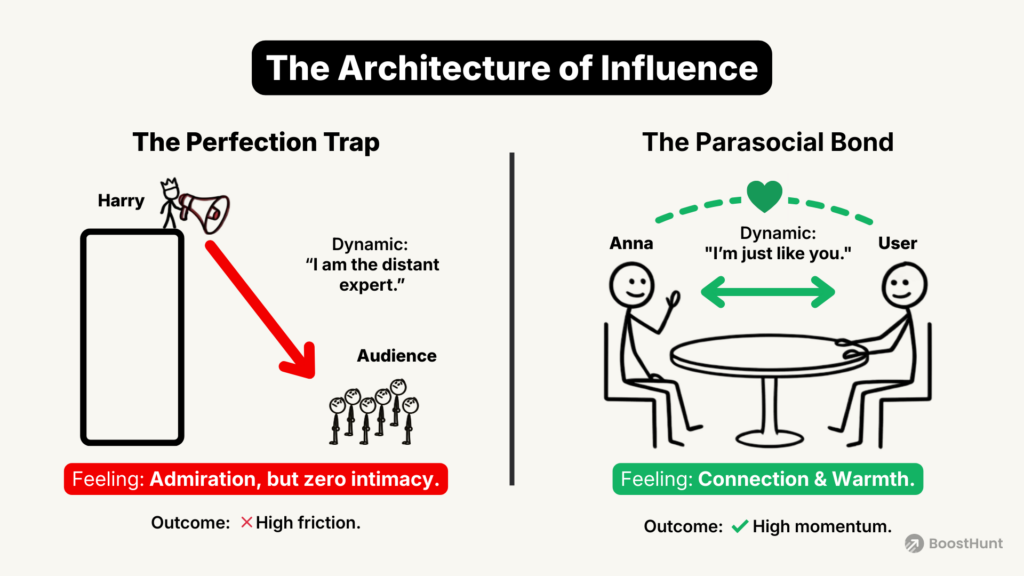
Harry wants to look like an expert. His landing page is polished to perfection: high-def logos, stock photos of “successful people,” and third-person copy reading, “Harry Smith is a Certified Professional with 5 years of experience.”
The Result: The visitor lands and feels… nothing. The page is cold. It signals “Marketing,” and the modern brain has evolved a biological filter to ignore marketing. In 2026, perfection looks suspicious. It looks like AI.
Harry’s Visitor: “This looks like a generic corporate template. Is this even a real person or just an AI-generated brand? I don’t see a human here, just a sales pitch. Closing tab…”
✅ Anna’s Approach: The Vulnerability Signal
Anna understands that the brain doesn’t bond with logos; it bonds with biological cues. She strips away the corporate veneer. Her page opens with a raw, handheld video. She’s in her living room, holding a coffee, looking directly into the lens: “I struggled with this for years. I almost quit twice. Here is the messy, honest truth about how I found a solution.”
Anna doesn’t just sell information — she sells an experience-based course built on human connection.
The Result: The visitor’s brain releases oxytocin (the bonding chemical). They think: She is real. She is like me. I trust her.
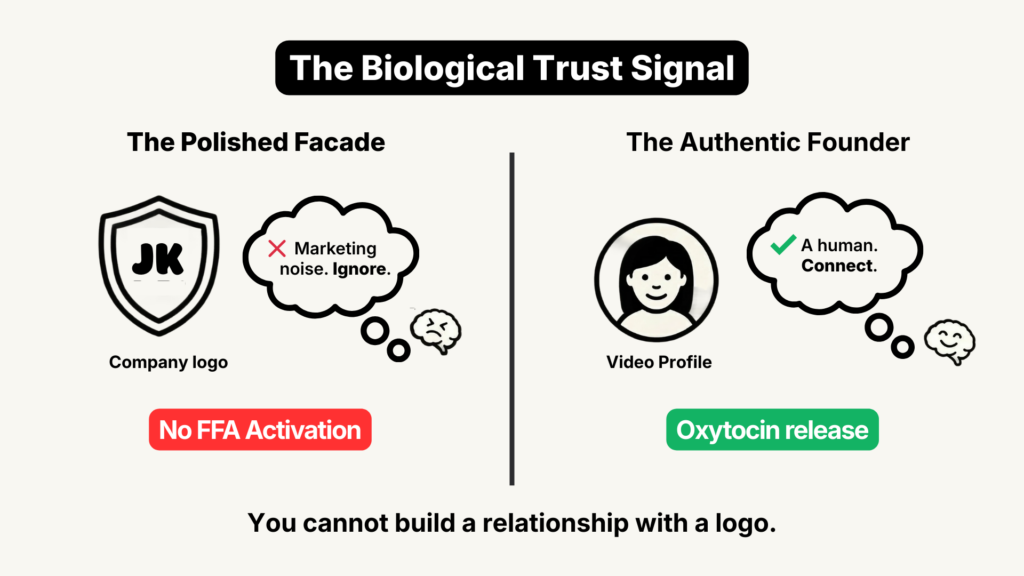
Anna’s Visitor: “Oh, she looks like she’s actually been through this. If she can solve it, maybe I can too. She looks tired but happy—just like I want to feel. I think she actually ‘gets’ me. I’ll watch just one more minute.”
How Your Face Becomes a Trust Magnet
🧠 THE PSYCHOLOGICAL LAW
Parasocial Interaction & The Biology of Trust
Parasocial Interaction is a phenomenon where an audience develops a one-sided sense of intimacy with a media persona. They feel they know you, even though you have never met.
Why? It’s rooted in biology. The Fusiform Face Area (FFA) is the part of the brain dedicated solely to processing faces. When you look directly into a camera lens, you “hack” this system. The brain processes your digital face similarly to a physical one, triggering the same “Friendship Protocols” used in real life.
This isn’t just marketing theory; it’s neurobiology. As established in the landmark study on the Fusiform Face Area, our visual system is hard-wired to prioritize faces over objects. This biological mechanism is the foundation of trust in a digital environment.
This is the same Parasocial Interaction I broke down in Psychological Triggers for Course Sales.
In the era of deepfakes, your imperfections—a shaky camera, a dog barking—are your Proof of Humanity.
Harry hides behind a logo, so the brain remains silent. Anna shows her face, and the brain starts building a bond.
This is the cornerstone of the experience economy: consumers seek memorable, immersive, and emotionally resonant experiences rather than just goods. By activating the FFA (Fusiform Face Area), Anna provides the human-centric leadership that learners in 2026 demand.
In an era of deepfakes, the FFA has become a “Bullshit Detector.” It doesn’t just look for a face; it looks for biological signals.
Harry uses “perfect” stock photos or AI avatars. The visitor’s brain flags this as “Non-Biological” and goes into defensive mode.
Anna uses High-Trust Imperfection. Her raw video includes a dog barking or a slight stutter. This “Digital Authenticity” signals to the brain that there is a real human on the other side. This isn’t just marketing—it’s Neuro-Verification
Scaling Commitment: The Behavioral Psychology of the “Ask”
(The Battle for Commitment)
Once you have attention, you need commitment. This is where most creators lose the sale before it even begins.
🛑 Harry’s Approach: The Impossible Jump
Harry runs ads directly to his $200 flagship course. He meets a stranger and expects them to take a massive leap of faith.
The Result: The visitor panics. The risk is too high. Harry is asking them to jump onto the roof without a ladder. They fall (and click “X”).
The UX Error: Harry tries to force a transaction without building a foundation of agreement.
Harry’s Visitor: “Whoa, $200? I just met you. What if this is a scam? What if it’s just 10 hours of fluff? The risk is too high.”
✅ Anna’s Approach: The Commitment Ladder
Anna doesn’t ask for $200 yet. She knows that trust creates friction, and friction kills sales. Instead, she builds a Commitment Ladder. She starts with the first rung: a “Tripwire” offer—a $7 toolkit or a “Morning Routine Checklist.” It is a “no-brainer” decision. The visitor pays the $7. Suddenly, a psychological switch flips. They climb from “Lurker” to “Customer.”
The Result: Anna has acquired a customer effectively for free. When she later offers the $200 course (the next rung), the user is already climbing.
Anna’s Visitor: “It’s only $7? That’s less than my lunch. Even if it’s bad, I won’t miss the money. And that checklist is exactly what I need right now. Let’s do it.”
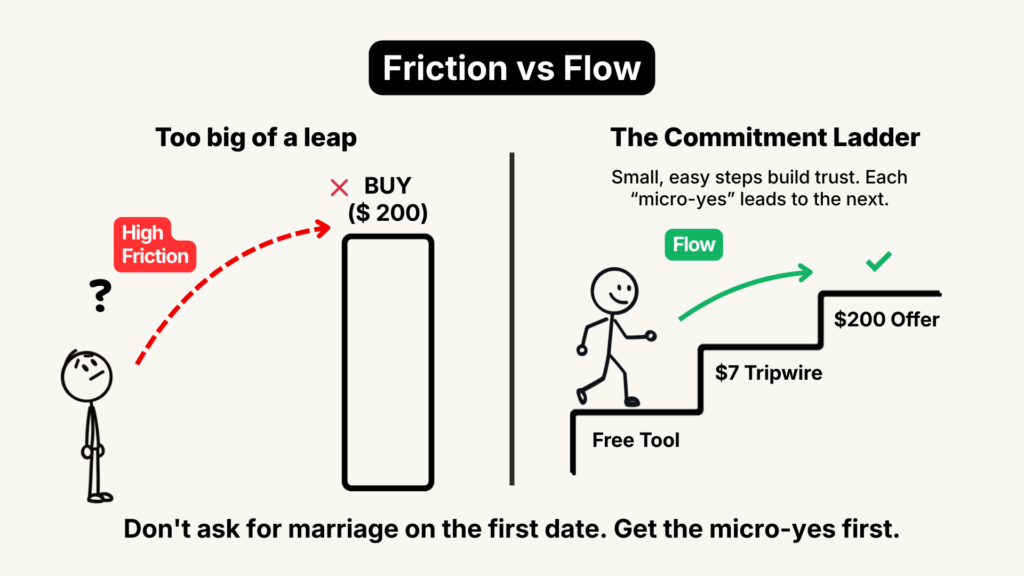
The Impossible Jump vs The Commitment Ladder
🧠 THE PSYCHOLOGICAL LAW
Consistency & The Commitment Ladder
This strategy leverages what Robert Cialdini defines as the Principle of Consistency. Once we take a small stand—like spending $7—we encounter internal pressure to behave consistently with that new identity. This is the “Foot-in-the-Door” technique (Freedman & Fraser, 1966): by getting the user to agree to a small request, you exponentially increase the likelihood they will agree to the $200 request later.
This Commitment Ladder is one of the most powerful foundations of a true experience-based course.
By getting the user to make a small, low-risk commitment (stepping on the first rung), Anna triggers an internal pressure. The user’s brain signals: “I am the kind of person who invests in this solution.”
From a UX perspective, Harry’s store is a “Decision Minefield.” To buy his $200 course, the user has to create an account, verify an email, and fill out 12 form fields. Every field is a drop-off point. Anna, however, uses Micro-Conversions. By offering a $7 toolkit, she reduces the “Pain of Paying” (a real neurological response in the insular cortex). Once the user has paid $7, the “Buyer’s Identity” is locked in.
Choice Architecture: Pricing Strategies that Drive Momentum
(The Battle for Value)
The customer is ready to buy. But just because they want it, doesn’t mean they will pay for it. The brain evaluates price based on context, not intrinsic value.
🛑 Harry’s Approach: The Isolation Error
Harry lists his course simply: “Price: $197.”
The Result: The visitor stares at the number. Their brain instantly compares this number to the only other reference point available: $0 (keeping the money in their pocket). The internal dialogue is: “That is almost $200. That feels like a loss.” They hesitate. They leave to “think about it.”
The UX Error: Harry forces the user to judge value in a vacuum. He ignores Anchoring.
Harry’s Visitor: “$197 is a lot of money right now. I could buy a new pair of shoes or four dinners out for that. I’m not sure if a ‘course’ is worth a week’s worth of groceries.”
✅ Anna’s Approach (The Decoy Strategy):
Anna never presents a price in isolation. She presents a “Choice Architecture” designed to guide the decision. She lists three options:
- The DIY Guide: $97 (The “Anchor” to set the floor).
- The VIP Coaching: $1,997 (The “Decoy”).
- The Full Course: $197 (The “Target” – Highlighted).
The visitor looks at the $1,997 option and thinks, “Wow, that is expensive.” Then their eyes drift to the $197 course. Suddenly, the math changes. It isn’t “$200 expensive.” Instead, it stands out as 10x cheaper than the VIP option. This context makes it feel like a bargain.
The Result:Anna sells the exact same product as Harry, but her customers feel like they won a deal.
Anna’s Visitor: “The VIP option is $2,000?! Wow. Wait, the Full Course is only $197? That’s 90% off the top tier. I’d be crazy to pay for coaching when I can get the same system for a fraction of the price. This is a steal.”
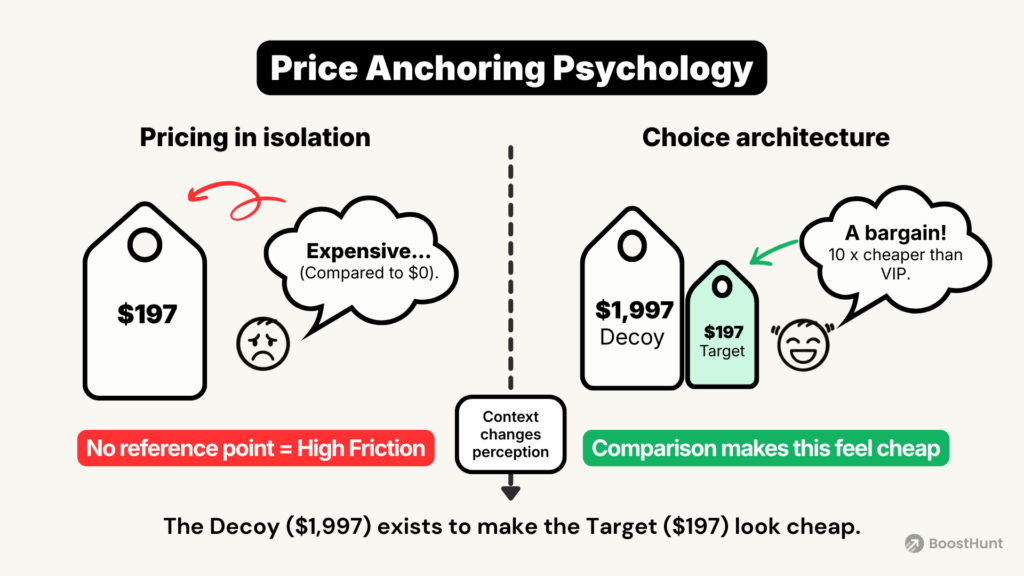
This shift in perception is what Dan Ariely describes in Predictably Irrational. Humans rarely choose things in absolute terms. We don’t have an internal “value meter” that tells us how much a course is worth. Instead, we focus on the relative advantage of one thing over another. By introducing a high-priced “Decoy,” Anna gives the brain a reference point that makes the Target price feel like an objective bargain.
🧠 THE PSYCHOLOGICAL LAW
The Decoy Effect (Asymmetric Dominance)
This is a specific application of Anchoring. The human brain is terrible at judging absolute value (e.g., “Is this course worth $197?”). However, it is excellent at judging relative value (e.g., “Is A better than B?”).
By introducing a “Decoy”—a high-priced option that most people won’t buy—Anna changes the context. The Decoy exists solely to make the Target option look rational and attractive by comparison.
Beyond Content: Automating Student Engagement and Retention
(The Battle for Retention)
The sale is made. But in the subscription economy, the sale is just the beginning. Harry thinks the job is done. Anna knows the real work—retention and LTV (Lifetime Value)—just started.
🛑 Harry’s Approach: The Content Mountain
The user buys Harry’s course. They receive a generic email: “Here is your login.” They log in and see 50 hours of video content organized into 10 modules.
The Result: It looks like a mountain of work. The user thinks: “I don’t have time for this right now.” They watch 10 minutes, get overwhelmed, and close the tab.
The Outcome: Harry gets high refund rates, zero testimonials, and no word-of-mouth referrals.
The UX Error: Harry creates Cognitive Overload.
Harry’s Student: “Fifty hours of video? I have a job and a family. I’m already behind. I’ll start this on Monday… maybe. I feel guilty every time I look at this login.”
✅ Anna’s Approach: The Momentum Loop
The user logs into Anna’s course. The first thing they see is a Progress Bar. But it isn’t at 0%. It is already at 20%. (Note: Anna credits them 20% just for signing up and joining the community). Below the bar is a “Quick Win” module labeled: “Get your first result in 10 minutes.”
The Result: The user feels momentum before they even watch a video. They feel closer to the finish line. As they watch the short video and get a result, a rush of dopamine floods their brain. Just like that, they are hooked.
The Outcome: Anna’s students finish the course. They get results. They become evangelists for her brand.
Anna’s Student: “Wait, I’m already 20% done? I only just logged in! Okay, let me just finish this 10-minute ‘Quick Win.’ Wow, I actually did it. I’m actually making progress. What’s next?”
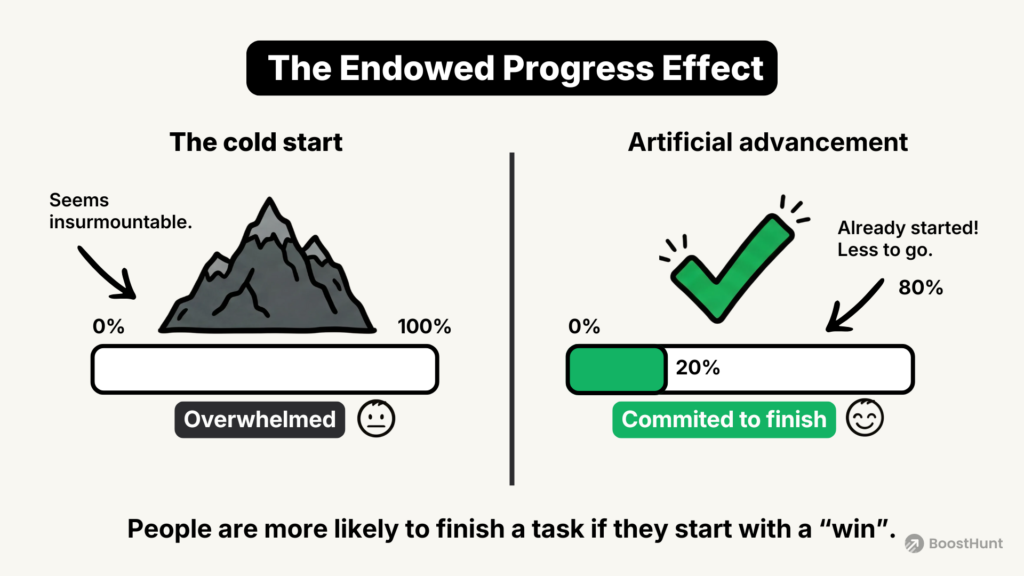
🧠 THE PSYCHOLOGICAL LAW The Endowed Progress Effect A famous study by Nunes and Drèze (2006) showed that people are significantly more likely to complete a task if they are given an “artificial” head start. By framing a task as having already been undertaken, you eliminate the “Cold Start” friction. You aren’t just giving them a progress bar; you are closing the “Open Loops” that would otherwise cause cognitive fatigue.
By giving the user a “head start” (the 20% fill), Anna reframes the task. The user isn’t starting from the bottom of the mountain; they are already on the way up.
Harry’s 50-hour course is a massive, exhausting open loop that the brain instinctively wants to avoid. Anna uses Visual Momentum. By pre-filling 20% of the progress bar, she tricks the brain into wanting to finish the task. It’s the difference between standing at the bottom of a mountain and being air-dropped onto the first ridge.
The Solution: Building a Psychological Ecosystem for Your Course
Eliminating the “Cognitive Tax” of the Modern Creator
We have analyzed what Anna does right. But the real question is: How does she do it without burning out?
The answer lies in Cognitive Load Theory. Every human has a limited amount of working memory. When you are a creator, your mental energy is your most valuable capital.
The Harry Trap: Why Most Creators Can’t Build a Real Experience-Based Course
Harry understands he needs a sales page, a checkout flow, and a delivery system. To build this, he becomes a “Systems Administrator.” He stitches together a “Frankenstein Stack”:
- A website builder for the “look.”
- A separate checkout for the money.
- An email provider for the automation.
- A plugin for the content.
This creates a massive Cognitive Tax. Harry spends 80% of his energy managing API keys, fixing broken links, and worrying about “if the tools are talking to each other.” By the time he sits down to write his sales copy, his brain is fried. He has zero “empathy-reserve” left to think about his students’ psychology.
The Anna Advantage: The “Behavioral Architect”
Anna refuses to pay the Cognitive Tax. She knows that in 2026, Complexity is the enemy of Execution. She doesn’t want to be a CTO; she wants to be an Architect.
| 🛑 The “Harry” Way (Systems Admin) | ✅ The “Anna” Way (Behavioral Architect) |
| Tech Stack: 5+ plugins, 3 subscriptions. | Tech Stack: Unified Ecosystem |
| Focus: Fixing broken API links. | Focus: Writing high-empathy copy. |
A “Frankenstein Stack” isn’t just a technical headache—it’s a conversion killer. As explained in this deep dive into Hick’s Law by the Interaction Design Foundation, the time it takes to make a decision increases logarithmically with the number and complexity of choices. When your tech is disjointed, you increase Cognitive Load on your customer—making their brain work too hard to buy.
Recent data shows that 57% of creators are delayed by the ‘tech burden’, often spending 80% of their time on ‘admin’ instead of teaching. The solution isn’t adding more tools—it’s reducing cognitive overhead.
Modern creators need:
- Unified Ecosystem (newsletter, products, and checkout in one place—no “gluing” tools together).
- Frictionless by Default (high-converting page templates built on behavioral principles).
- Zero-config deployment (pre-built frameworks that let you launch in days, not months)
When you aren’t fighting your software, you finally have the mental space to connect with your students.
💡 Want this ecosystem built for you? BoostHunt implements these principles as a done-for-you service. Learn more →
🛠 The Blueprint
Goal: Pass the Neuro-Verification test for your experience-based course.
| 🚩 The Symptom (Are you Harry?) | 🧠 The Diagnosis (Psychology) | ✨ The 10-Minute Fix (Be Anna) |
|---|---|---|
| “High traffic, but users leave almost immediately (Bounce).” | The Uncanny Valley Effect. In 2026, the brain unconsciously rejects polished stock media as “AI Noise.” If it looks perfect, it feels fake. | The “Human Signal”: Replace your hero image with a raw, 60-second “living room” video or an action shot of you. Force the brain to engage with a real face. |
| “About Me” reads like a dry LinkedIn CV.” | The Pratfall Effect. Perfection creates distance. We don’t trust people who have never failed; we suspect they are lying. | The “Origin Wound”: Rewrite your bio. Don’t just list wins; share the specific failure or “wound” that forced you to build the solution you are now selling. |
| “They don’t believe my promises.” | Skepticism Shielding. In a high-scam era, claims are ignored. The brain filters out adjectives (e.g., “amazing,” “expert”). | The Evidence Artifact: Delete adjectives. Insert a screenshot of a specific result (a bank stripe, a client DM, a data chart). Concrete evidence bypasses the skepticism filter. |
LEVEL 2: THE OFFER (Desire)
Goal: Turn lurkers into buyers in your experience-based course.
| 🚩 The Symptom (Are you Harry?) | 🧠 The Diagnosis (Psychology) | ✨ The 10-Minute Fix (Be Anna) |
|---|---|---|
| “They consume my free content but won’t pay.” | The Identity Gap (Commitment Principle). They identify as “Consumers,” not “Investors.” You need to break that identity, not just sell a product. | The “Pocket Change” Tool: Offer a tool (not just a PDF) for $7–$27. The goal isn’t profit; it’s to force the micro-commitment that flips their switch to “Customer.” |
| “They add to cart but abandon it.” | Decision Fatigue (Hick’s Law). Every extra form field costs you 10% of your conversions. You are asking for data, not a sale. | The Friction Audit: Remove “Phone Number,” “Company Name,” and “Create Account” steps. Make the checkout strictly “Card and Go.” |
| “They say it’s too expensive.” | Vacuum Pricing. A price seen in isolation is always “expensive.” The brain has no reference point other than $0 | The Decoy Effect: Place a $1,500 “VIP/Done-For-You” option next to your $150 course. The $1,500 option makes the $150 option look like the “smart, logical choice.” |
LEVEL 3: THE SYSTEM (Retention)
Goal: Automate retention and momentum in your experience-based course.
| 🚩 The Symptom (Are you Harry?) | 🧠 The Diagnosis (Psychology) | ✨ The 10-Minute Fix (Be Anna) |
|---|---|---|
| “Low completion rates or high refund requests.” | Buyer’s Remorse (The Cold Start). The moment after purchase is peak anxiety. “Did I make a mistake?” Silence fuels this fear. | The “Dopamine Drip” Email: Send an automated email 2 minutes post-purchase with a direct link to a “Quick Win” video. Give them ROI before they even log into the member area. |
| “No word-of-mouth or referrals.” | Lack of Tribal Signaling. People don’t refer “products”; they refer “identities.” They want to signal who they are. | The Identity Label: Stop calling them “Students.” Call them “Architects,” “Creators,” “Insiders.” Naming the tribe creates belonging. |
| “Students log in once and never come back.” | The Motivation Valley. A long course looks like a mountain. The brain predicts high effort and triggers avoidance. | The “Power Start”: Re-engineer Module 1. It must be finishable in <20 minutes and produce a tangible asset. Closing this small loop releases the dopamine needed to start Module 2. |
📊 YOUR ARCHITECT SCORECARD
How many “Anna” fixes have you implemented?
- 0-3 Fixes: 🔴 CODE RED. You are drowning in “Systems Debt.” Your business is high-friction and low-trust.
- 4-6 Fixes: 🟡 YELLOW ZONE. You have a business, but it’s leaking revenue. You are working harder than your tools are.
- 7-9 Fixes: 🟢 GREEN ZONE. You are a Behavioral Architect. You have built an ecosystem, not just a store.
Note: Moving into the ‘Green Zone’ is not about adding more tools, but about stack orchestration—letting technology become invisible so your expertise can shine.
Conclusion
Stop Building Stacks. Start Building Relationships.
The era of the “Complex Funnel” is ending.
Therefore, the winners of 2026 won’t be the creators with the most complicated automations. They will be the Essentialists.
“Harry” is broke because he is drowning in complexity. His expensive tech stack is actually a barrier between him and his students. “Anna” is scaling because she simplified. She uses technology that is invisible, allowing her personality and her psychology to shine through.
You have a choice. You can keep selling information… or you can build a true experience-based course in 2026 — one that AI can never replicate.
If you want the entire tech part of this ecosystem built for you, see how we do it in Hidden Costs of Online Course Platforms 2026.
FINAL ADDITION: The Scientific Footnote
📚 Scientific Foundations & Further Reading
The “Behavioral Architect” approach is built on the following research:
-
Face Perception: Kanwisher, N., et al. (1997). The Fusiform Face Area. Journal of Neuroscience.
-
Consistency & Influence: Cialdini, R. B. (2021). Influence: The Psychology of Persuasion. > Relativity in Pricing: Ariely, D. (2008). Predictably Irrational. HarperCollins.
-
Endowed Progress: Nunes, J. C., & Drèze, X. (2006). The Endowed Progress Effect. Journal of Consumer Research.
-
UX & Cognitive Load: Hick’s Law: Making the choice easier. [Nielsen Norman Group].