By Magdalena Białaczewska-Krzanowska Co-founder of BoostHunt & UX Strategist with 10+ years of experience in UX Design.
The dream was simple: share your expertise, transform lives, and build a scalable business. But for many American course creators in 2026, that dream is buried under a mountain of API keys, broken Zapier automations, and CSS tweaks.
As a UX designer who has spent a decade auditing hundreds of user flows, I’ve realized that the biggest threat to your 2026 launch isn’t your marketing—it’s your tech stack’s Cognitive Tax. If you feel more like a frustrated IT admin than an educator, you aren’t just tired; you are suffering from a systemic business failure.
What is the “Cognitive Tax” in Course Creation?
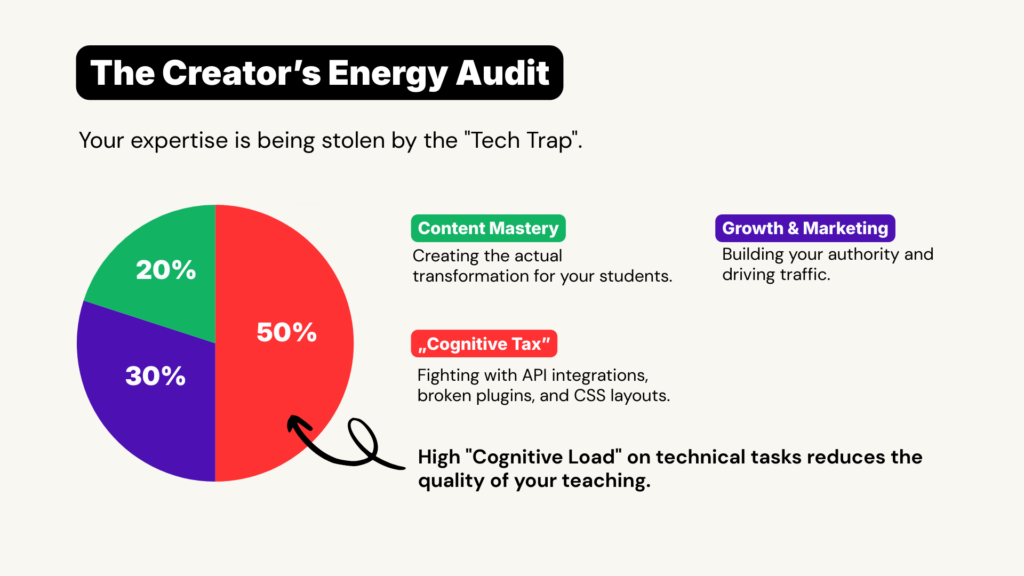
Every time you stop creating content to figure out why your checkout page isn’t syncing with your email list, you pay a “Cognitive Tax.” This isn’t just a metaphor; it’s a principle of behavioral science.
As documented in John Sweller’s research on Cognitive Load Theory, humans have a finite amount of working memory. When your brain is occupied with “how to fix a webhook,” it literally lacks the neural capacity to focus on “how to teach better.” In the 2026 experience economy, technical friction kills the human connection that justifies your premium price point.
The “Silent Revenue Killer”: A Case Study in Tech Friction
During a recent audit for a mid-scale course launch, we discovered a 4% “leak” in the funnel. The cause? A minor update in Stripe’s metadata structure meant that Zapier couldn’t parse the “Customer_Email” field correctly under specific mobile browser conditions.
The result: 4 out of every 100 students paid their $197 fee but never received their login credentials. They didn’t get an error message; they got silence. This led to manual support tickets and brand distrust—a technical failure that no “all-in-one” platform warned the creator about.
Why All-in-One Platforms Often Lead to More Complexity
Most creators think the answer is to buy another “all-in-one” tool. However, these tools often lead straight into LMS integration hell. You buy the software, but you still have to build the house.
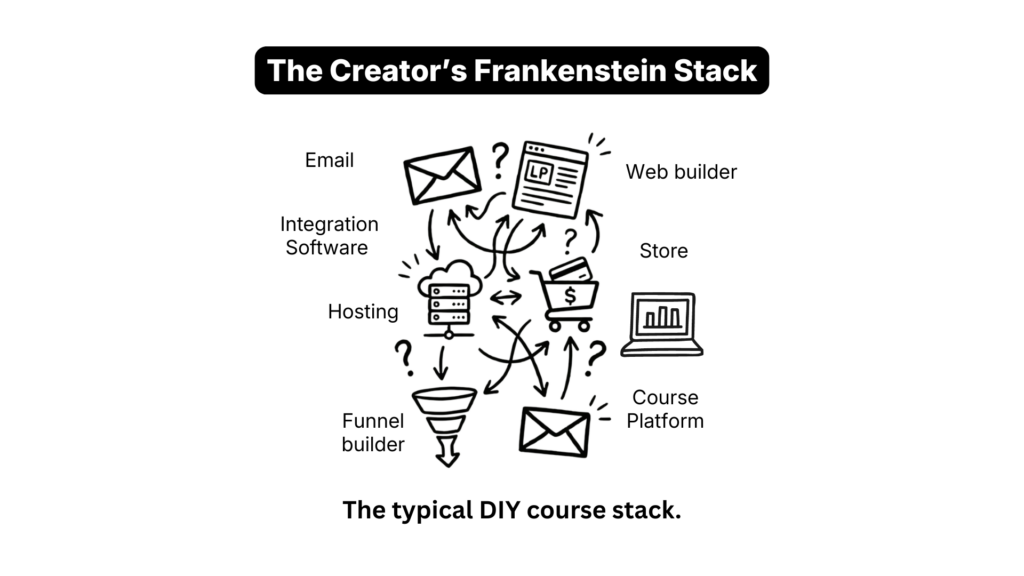
Consider the typical “simple” launch stack:
-
A platform for hosting (Teachable/Kajabi)
-
An email service provider (ConvertKit/ActiveCampaign)
-
A payment gateway (Stripe/PayPal)
-
A bridge to connect them (Zapier/Make)
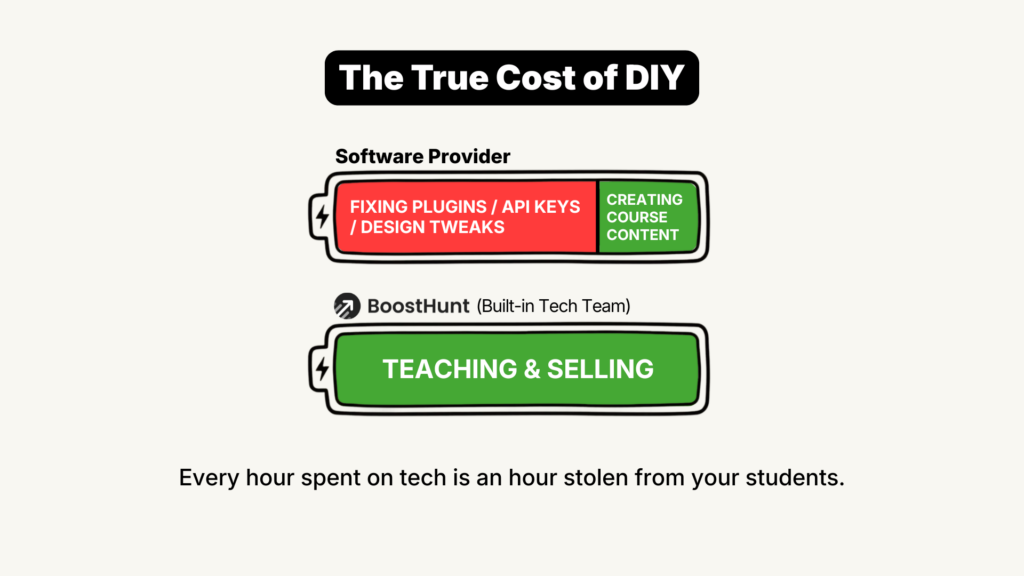
You spend your time on support chats instead of coaching and quickly realize there are hidden costs to online course platforms in 2026 that go beyond the monthly subscription.
Data from Baymard Institute shows that complex, non-optimized checkouts are the leading cause of revenue loss—yet most DIY platforms offer very limited UX customization. If your platform doesn’t allow for high-converting behavioral UX, you are paying for that “simplicity” with your conversion rate.
The Hidden Costs of Teachable and Kajabi Most Creators Ignore
While Teachable and Kajabi are two of the most popular platforms for course creators, many only discover their true costs after months — or even years — of use. Beyond the monthly subscription, the real expenses show up as transaction fees (especially on Teachable’s lower plans), the need for additional tools like ConvertKit or Zapier, and hours spent every week troubleshooting broken automations when APIs change.
These “small” issues quickly turn into a heavy Cognitive Tax. You lose precious mental energy fixing webhook failures, chasing email deliverability problems from shared IP addresses, and working around rigid checkout designs that can’t be fully optimized for conversions.
Data from the Baymard Institute’s large-scale checkout usability research shows that the average large e-commerce site can increase its conversion rate by over 35% simply by reducing friction in the checkout process. In the context of online courses, even minor issues — such as confusing form fields, poor mobile optimization, or forced account creation — can quietly cost creators thousands in lost revenue every launch.
Comparison: DIY LMS Platforms vs. Managed Infrastructure
| Feature | DIY Platforms (Kajabi/Teachable) | BoostHunt (Productized Service) |
| Setup Speed | Weeks/Months (DIY) | 7-10 Days (Done-for-you) |
| Customization | High (Infinite, if you can code) | Moderate (Standardized for high conversion) |
| Technical Burden | High (You are the admin) | Zero (We are the admin) |
| Best For |
Creators who enjoy tweaking tools and have time to manage tech |
Established creators who want to focus 100% on teaching and student experience. |
| Control | Total control over every pixel | Focus on business, not pixels |
When BoostHunt is NOT for you: If you enjoy spending weekends tweaking CSS, or if you need a highly experimental, non-standard site architecture, a DIY platform or a custom $20k agency is a better fit.
How to Launch a Course Without a Developer in 2026
The most common question I get is: “How do I launch without hiring a developer?“ The answer in 2026 is the Productized Service model. This category bridges the gap between software and expensive agencies.
What Is a Productized Service for Course Creators?
Definition: A productized service — also known as done-for-you online course infrastructure — is a fully managed solution where the provider delivers both the technical platform and the hands-on execution (setup, funnels, automations) for a fixed monthly fee. It sits between a DIY tool (Kajabi) and a high-ticket custom agency.
By choosing done-for-you online course infrastructure, you completely outsource the technical risk. You don’t need to know what a webhook is — you simply bring your expertise, and the launch happens smoothly
Escape the Fatigue: Join the Beta Group
We’re in the early stages of building what we believe will become the new standard for course infrastructure. Instead of looking for traditional customers, we’re inviting a small, selective group of beta partners — experienced creators who are done spending their weekends fighting tech issues.
If you’re selected, we’ll design and manage your complete technical infrastructure and sales funnel inside tour ecosystem at no upfront cost during the beta period. In exchange, we ask for your honest feedback and the opportunity to document the results as a case study.
This is a true partnership. We succeed only when you succeed.
Stop paying the Cognitive Tax. Start being the Architect. Apply for the BoostHunt Beta Partnership Here