You’ve nailed the content. Your curriculum is gold. But then the tech nightmare hits: Endless hours tweaking tools. Integrations fail. Your launch date slips away.
It’s a harsh reality: Great content doesn’t sell itself if the delivery system is broken.
Before co-founding BoostHunt, my team spent a decade running a UX/UI studio. We crafted interfaces for complex, high-stakes products. When we finally entered the course creation space, we noticed a disturbing trend: talented creators were pouring energy into teaching, while clunky, fragmented tech silently eroded their profits.
We kept hearing the same story: “I’m paying for five subscriptions, acting as my own IT manager, and every launch still feels like Russian roulette.”
If you are diving into online courses, avoiding tech pitfalls is critical. Overcoming course creation tech fatigue isn’t just about saving time—it’s the difference between a thriving business and a stalled side hustle.
Based on our audits of plenty of setups, here are the three revenue-draining mistakes to avoid.
🧩 Mistake 1: The Frankenstein Tech Stack & The DIY Integration Tax
The Problem: Wasting critical time acting as an IT manager instead of a creator.
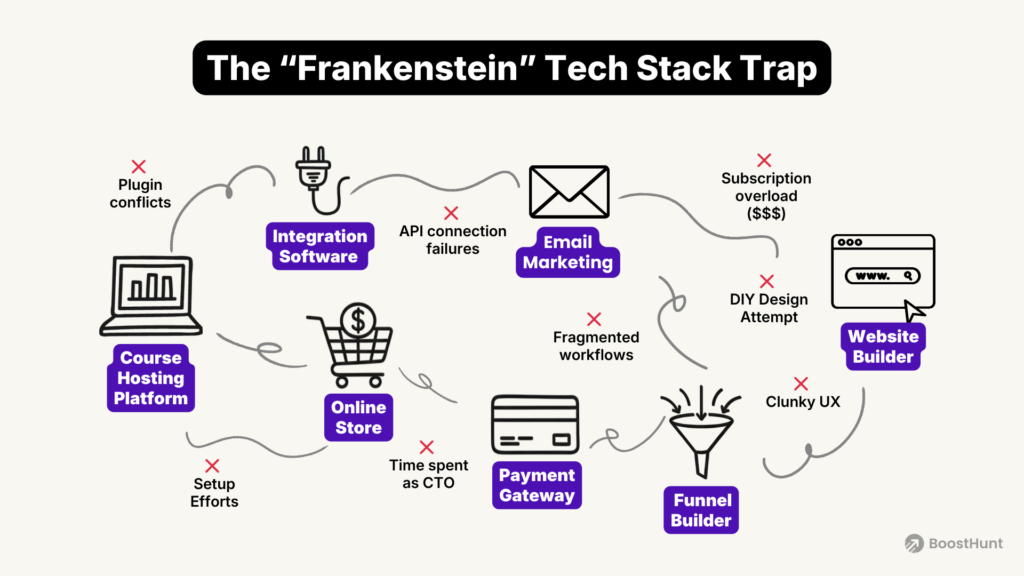
Creators often start with a patchwork of tools: WordPress for the site, Mailchimp for emails, Stripe for payments. As they scale, they realize these tools don’t talk to each other.
Even when creators switch to popular “All-in-One” platforms like Kajabi or Teachable, they often find themselves still needing glue like Zapier to handle advanced email automation or custom design tweaks. Suddenly, your ‘All-in-One’ solution requires three extra subscriptions to function. We call this the ‘Integration Tax.’ Instead of teaching, you spend your energy solving LMS technical problems that shouldn’t exist in a professional setup. Every tool you add creates a new point of failure. When you have 5 tools, you have 10 possible breaking points where data can leak or a student can lose access.
But here is the deeper trap:
Most platforms hand you the software login and say, “Good luck.”
You are left to build the website, configure the checkout, and design the layout from scratch. You get stuck in an endless loop of configuring plugins, testing themes, and troubleshooting API keys.
We call this Setup Purgatory. Every hour you spend fighting with a “drag-and-drop” builder is an hour stolen from your students.
The Cost:
- Time: Weeks of launch delays trying to make tools communicate.
- Money: $500+/month in scattered subscription fees (Platform + Zapier + Email Tool + Plugins).
- Sanity: Burnout from managing a “second startup” just to keep your infrastructure running.
“Most creators are juggling half a dozen tools that were never designed to work together. The current monetization stack is fragmented, inflexible, and not built for scale.” — Forbes: “Inside The Rise Of The Creator CEO Movement”
“Juggling multiple platforms for content creation, analytics, and monetization is both inefficient and overwhelming. This fragmentation stifles growth and deters aspiring creators from entering the space.” — Forbes’ “Setting The Stage: How To Empower Creators And Redefine E-Commerce”
✅ How to fix it
To escape “Setup Purgatory,” you need to shift your mindset from using tools to owning an ecosystem.
- Audit your “Integration Tax”: Every time you add a tool (e.g., adding Zapier to connect Mailchimp to Teachable), you aren’t just paying for the subscription. You are paying a “tax” in the form of potential breaking points. When one API updates, your entire funnel can collapse.
- The 80/20 Rule of Creation: If you spend more than 20% of your time on “admin” or “tech,” your business is upside down. Professional creators outsource their infrastructure so they can stay in their “Zone of Genius.”
- Choose a “Done-For-You” ecosystem: Move from simple software to a managed service. This is the core difference with BoostHunt. We recognized that software alone isn’t enough. Unlike Kajabi or Teachable—which are “SaaS” (Software as a Service) platforms where the manual labor is still your responsibility—BoostHunt is a Managed Ecosystem. We don’t just give you the keys to an empty room; we build the house. We build your website, configure your store, and set up the course platform so you don’t wrestle with settings. You just upload your content and launch.
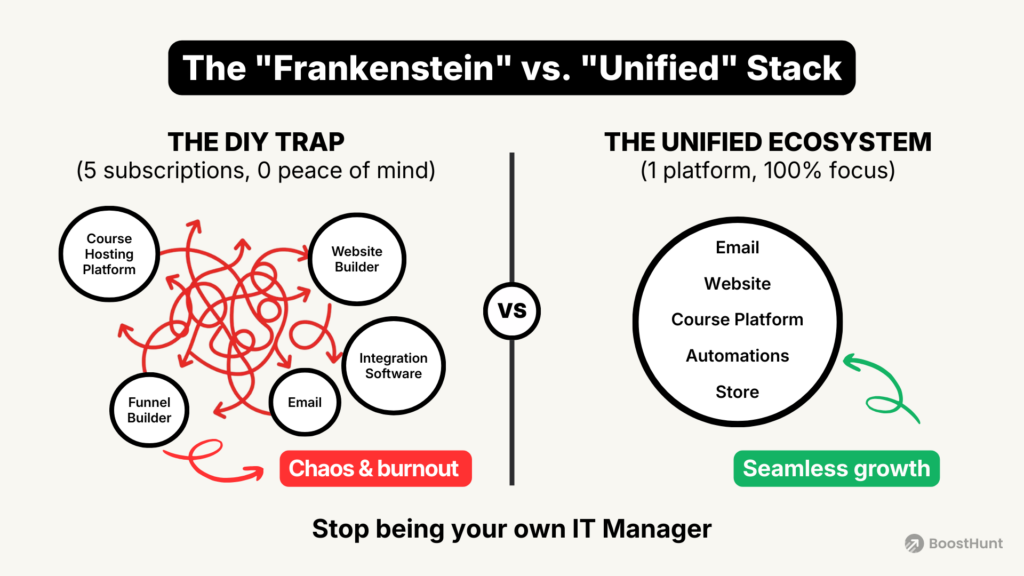
This is why we built BoostHunt as a managed ecosystem. Unlike standard SaaS platforms where the manual labor is your responsibility, we provide a done-for-you online course infrastructure that eliminates tech burnout from day one.
📈 Mistake 2: Ignoring Scalability & LMS Technical Problems
The Problem: You nail the launch. Sales trickle in. Then suddenly—bam. Your cheap hosting hits a wall. Emails lag, the site crashes under traffic, and support tickets pile up.
Beginners often think, “I’ll worry about scale when I’m big.” But in the digital world, speed is revenue.
Performance isn’t a luxury; it’s a requirement. Google’s research on mobile page speeds is clear: as page load time goes from 1 second to 3 seconds, the probability of a user bouncing increases by 32%. (Source: Google/Deloitte Mobile Speed Data)
If your DIY tech stack takes 5 seconds to load because of bloated plugins, you are losing a third of your potential revenue before a student even sees your curriculum.
✅ How to fix it
- Forecast growth: Map out the next 6 months. Will there be 100 students or 1,000? Choose hosting that expands effortlessly.
- Stress test the site: Use free tools like Google PageSpeed Insights. If your mobile score is below 80, your tech stack is costing you sales.
- Automate early: Set up email sequences and upsells now, so the system works while you sleep.
📱 Mistake 3: Poor Online Course UX (The Trust Killer)
The Problem: A potential student lands on your sales page. They’re excited. But the navigation is a labyrinth, the font is hard to read on mobile, and the checkout looks generic.
Poof—they’re gone.
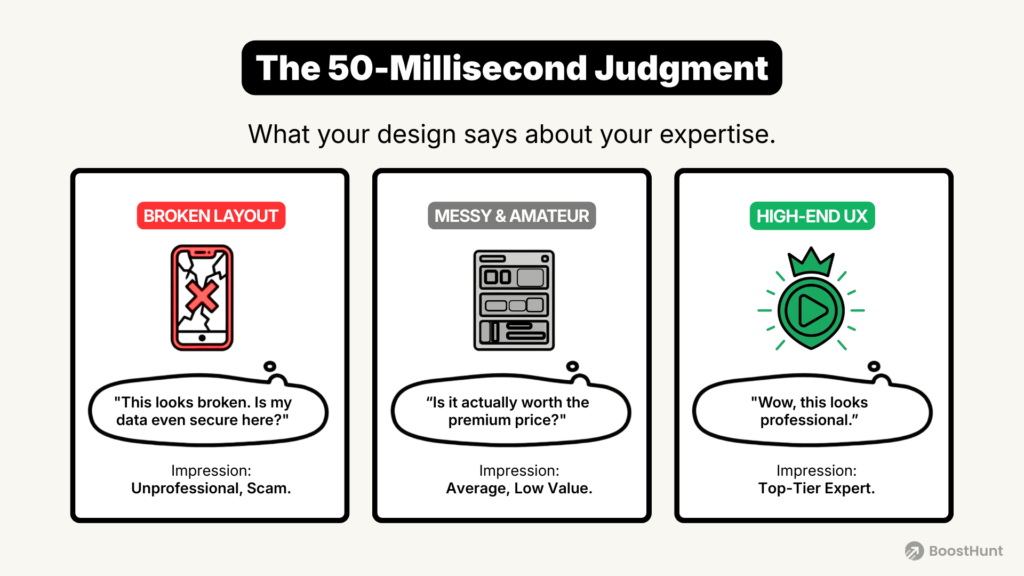
Many creators think design is just “making it pretty.” As UX professionals, we know that design is actually credibility management. The reality is that your students compare your course to the best apps they use every day—Netflix, Airbnb, and Uber. If your course feels like a 2010 WordPress blog, they won’t blame the tech; they will subconsciously lower their expectation of your expertise.
Design is credibility management. According to the Stanford Web Credibility Research Project, 75% of users judge a company’s authority based solely on website design. If your site feels outdated, 88% of visitors are unlikely to return after that single bad experience. High-quality online course UX is no longer a luxury; it’s your brand’s first handshake. Furthermore, the Nielsen Norman Group notes that users form these first impressions in just 50 milliseconds. If your platform looks broken or amateurish, students subconsciously assume your course content is low-quality, too.
“88% of users won’t return to a website after a bad experience. Imagine losing nearly 9 out of 10 visitors just because of poor UX!” (Source: UserGuiding)
✅ How to fix it
- Prioritize mobile first: Over 50% of your traffic will likely be mobile. If your checkout requires “pinching and zooming,” you are killing your conversion rate.
- Simplification: Fewer clicks, bolder CTAs. Guide users straight to the value without detours.
- Reduce friction: Every extra click in the checkout process drops conversion by huge margins.
- The Done-For-You Shortcut: If you aren’t a designer, don’t guess. Bad UX is expensive. At BoostHunt, we don’t just give you the software; our team builds high-converting pages for you using pro UX/UI principles, ensuring your brand looks professional from day one.
Conclusion: Stop tinkering, start teaching.
The solution isn’t working more hours. It’s building systems that work without you.
To recap, you must avoid:
- Wasting time on a fragmented “Frankenstein” setup.
- Ignoring scalability, which leads to site crashes during launches.
- Neglecting UX, which tanks trust and conversions.
Ready to stop playing tech support? If you want a fully done-for-you setup that handles hosting, automation, and design in one unified hub, let’s talk.